We get calls from parks departments, school athletic directors, and club coaches who are ready to pull the trigger on an artificial sports field — and then realize they’ve been quoting pile height specs without knowing what they actually mean. That’s not a knock on anyone. Artificial turf specifications are genuinely confusing, and the consequences of getting them wrong on a 50,000-square-foot field are a lot bigger than on a backyard install.
This guide covers the core decisions: face weight, pile height, infill selection, shock pad systems, and whether to build for one sport or many. We pull from what we see in the field, not a spec-sheet exercise. If you’re still working out square footage and budgets, our turf cost calculator is a good place to start the numbers conversation.
Key takeaways:
- Face weight and pile height are the two specs that most directly determine whether a sports field feels and plays right — learn both before comparing quotes.
- Infill selection is as important as the fiber itself; the wrong infill makes an otherwise good product perform poorly.
- A shock pad beneath the backing is now considered standard for contact sports and organized youth play.
- Multi-sport fields demand different spec trade-offs than single-sport fields — know your primary use before locking in a system.
Why Artificial Turf Specifications Matter More on Sports Fields
On a residential backyard, a turf that’s a bit too soft or too dense might look slightly different than expected. On a sports field, a spec mismatch can mean inconsistent ball roll, poor traction in cleats, faster fiber wear, or an unacceptable impact score. Athletic turf is engineered to perform under lateral load, repeated foot-strike, and thousands of hours of play — so understanding what the numbers on a data sheet actually represent is the first step to a good purchase.
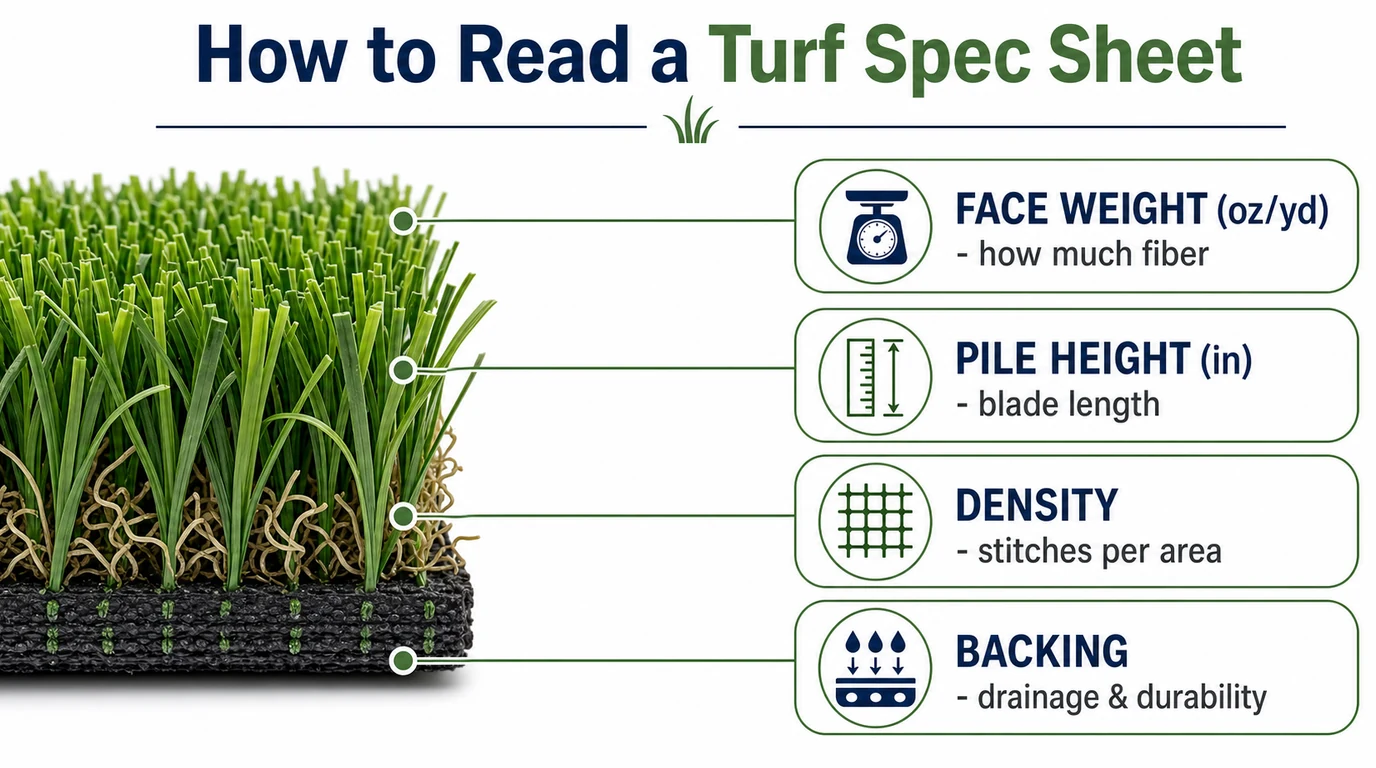
When our team evaluates a potential sports install, we look at four things before anything else: face weight, pile height, backing and drainage, and infill system. Everything else flows from those four.
Face Weight: The Density of What’s Underfoot
Face weight measures how many ounces of fiber are tufted into one square yard of backing. It’s the clearest single indicator of how durable a product will be under athletic load.
A low face weight (say, 30–40 oz) is fine for light-use landscaping or a putting green surround. For an athletic field that sees daily practice plus weekend games, that’s not enough material. The fibers will mat down, the field will lose its springback, and you’ll be looking at replacement much earlier than you planned.
For most sports field applications:
- 50–60 oz is a reasonable floor for lower-traffic fields (occasional community use, practice fields)
- 60–80 oz is the standard for organized league play and high school athletics
- Above 80 oz is used for premium fields with year-round, high-intensity schedules
A higher face weight adds cost, but the cost difference per year of useful life usually favors going heavier upfront. When you’re spec’ing a commercial athletic field or a facility that will be used morning to evening, skimping on face weight is a false economy.
Pile Height: Ball Roll, Traction, and Foot Feel
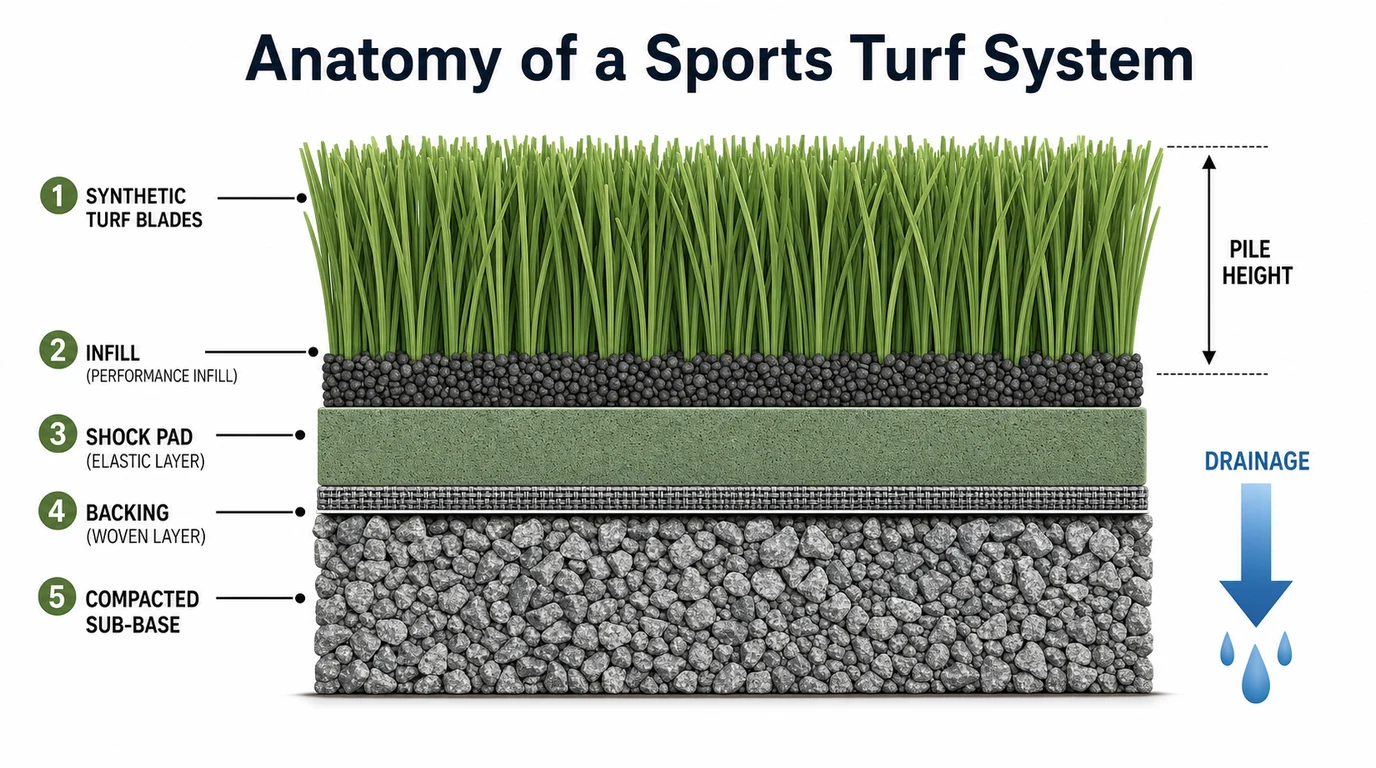
Pile height is the length of the fiber blades above the backing — measured before infill is installed. It directly affects how a ball interacts with the surface, how traction feels in cleats, and how soft the field feels underfoot.
The right pile height depends heavily on the sport:
Soccer and Multi-Use Football/Soccer Fields
A 2- to 2.25-inch pile is the sweet spot for soccer. It gives the ball enough surface contact for realistic roll and provides enough cushion that players aren’t planting into a hard surface. Many soccer field installs in the Southwest run this range because it also handles the foot-strike volume of a typical travel club’s weekly schedule.
Football and Lacrosse
Shorter pile — often 1.5 to 1.75 inches — is preferred. The stiffer surface gives better traction for football cleats and more consistent footing for lacrosse. Shorter pile also holds infill better, which keeps the field firmer underfoot.
Multi-Sport Courts and Training Surfaces
When a field needs to serve as both a soccer surface and a practice area for court-style drills, a compromise pile of 1.5 inches with a tightly specified infill system usually works best. You won’t perfectly optimize for either sport, but the field stays manageable across uses.
High-Density Advantage
One thing we see undersold in spec conversations: high-density turf — where stitch rate is high and the blades are packed tightly — performs significantly better in sports applications than lower-density products at the same pile height. Density determines how well the field holds its shape under lateral loads like cutting and pivoting. It’s worth asking for stitch rate alongside pile height when comparing quotes.
Infill: The Silent Performance Variable
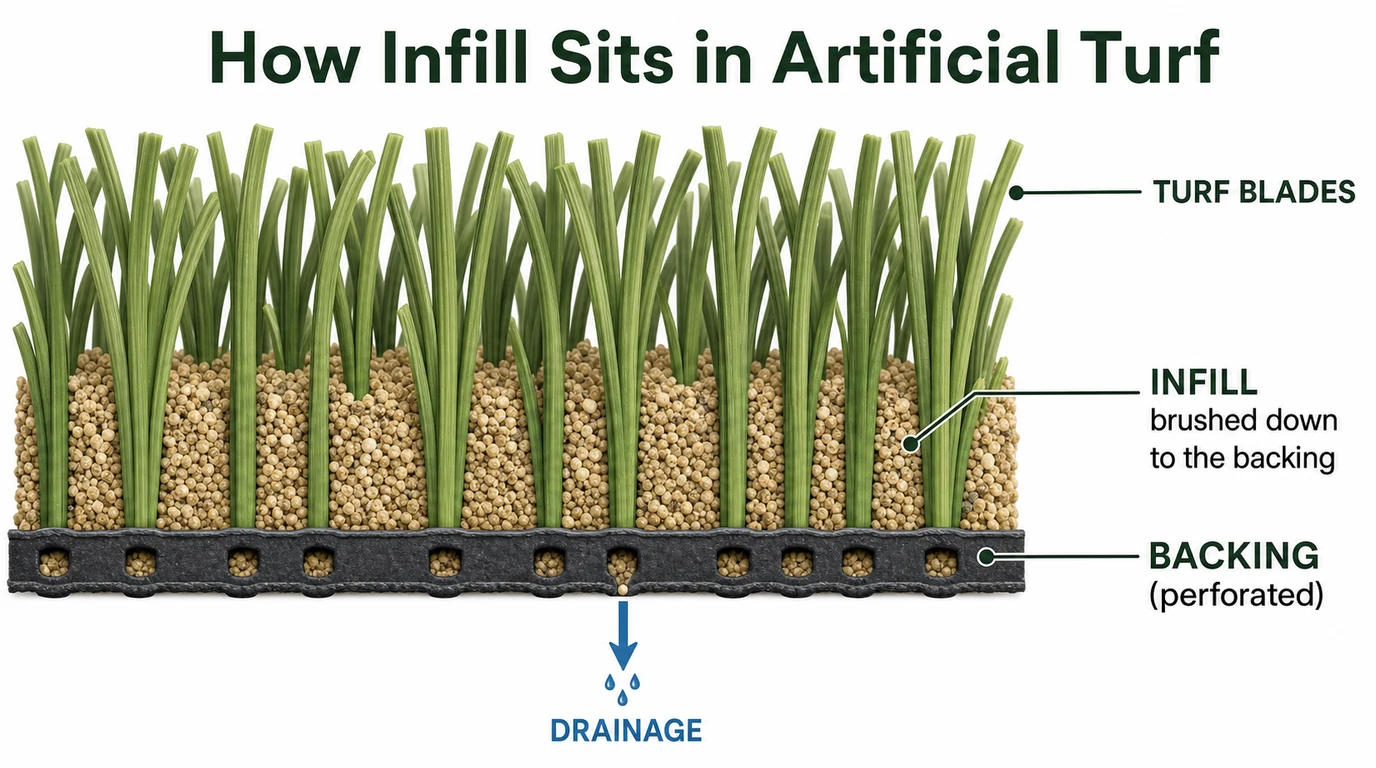
Infill is the material — sand, rubber, organic granules, or coated mineral — that’s broadcast into the pile after installation. It stabilizes the fibers, provides cushion, and in performance turf, plays a major role in shock attenuation, ball rebound, and traction.
The right turf infill for a sports field depends on the sport, the climate, and the budget:
Crumb Rubber (SBR or EPDM): The traditional sports field infill. Provides good resilience and shock absorption. Heavier and hotter than alternatives, which matters more in Arizona summer conditions.
Silica Sand: Used alone in lower-cost systems or as a base layer under rubber. Firm, consistent, and easy to top up. Good for fields where a harder, faster surface is acceptable.
Sand/Rubber Blended Systems: Common on multi-use fields. The sand provides stability and the rubber adds give. Proportions can be adjusted to tune the surface feel.
Organic and Coated Mineral Infills: Newer categories that run cooler than rubber and are increasingly specified for schools and parks with safety-focused purchasing policies. Cooling is meaningful in Arizona, where a south-facing field in July will retain heat in any dark infill.
Whatever system you select, infill depth needs to be maintained. Over time, infill migrates, compacts, and displaces — especially in high-traffic zones. Regular grooming and periodic top-ups are part of keeping a sports field performing correctly.
Shock Pads: When You Need One and Why
A shock pad is a foam or fiber underlayer installed between the compacted base and the turf backing. Its job is to reduce the peak impact force — what gets measured as the Gmax or HIC (Head Injury Criterion) score — that a player experiences when they fall or are tackled.
For competitive play — organized league games, high school athletics, and any contact sport — a shock pad is increasingly standard, and in many cases required by governing bodies or school district policies. Even for lower-level play, adding a pad is cheap insurance on an expensive field.
On multi-use athletic fields, a pad provides a consistent base that makes the surface perform more predictably across sports. Some pads are also designed to allow water to pass through, which matters for drainage on fields that see rain.
In Arizona, shock pads also help buffer against the thermal mass of a compacted base on a hot day. They’re not a cooling solution, but they add a layer of separation between the base and the players.
Multi-Sport vs. Single-Sport: Choosing a System
The most common question we get from parks and schools: “Can we build one field for everything?”
The honest answer is yes — with realistic expectations.
Single-sport fields can be dialed in precisely. A dedicated soccer field runs the fiber, pile, infill, and pad system that FIFA-quality play demands. A football-only surface gets the traction profile and shorter pile that coaches want. When a field is purpose-built, it performs best.
Multi-use athletic fields are a compromise — a calculated one. The most successful multi-sport specs we’ve worked with tend to:
- Use a mid-range pile (1.5–2 inch) that doesn’t fully optimize for any one sport but doesn’t hurt any of them
- Choose a blended infill that’s firm enough for football traction but gives enough for soccer comfort
- Install a shock pad to cover the range of impact expectations across sports
- Select a high face weight so the field survives the combined wear-and-tear of multiple teams
If you’re managing a tight budget and serving a school or a park with limited field space, a multi-sport system with a quality base and a good face-weight product is the right call. If you have the space and the budget, dedicated fields will always outperform.
Drainage: The Foundation Nobody Talks About Enough
Even the best turf system underperforms on a bad base. For sports fields, drainage is non-negotiable. Standing water on an athletic field after rain delays play, accelerates base erosion, and creates uneven infill distribution.
A well-designed sports field base uses a properly graded aggregate sub-base — typically decomposed granite or crushed stone — with a consistent fall to drain water quickly. The turf backing should also have a high-porosity perforation pattern.
Our sports turf installs use a carefully compacted base that gives us confidence in long-term performance, even through the monsoon season in Arizona. Drainage planning belongs in the spec conversation from the start, not as an afterthought.
Putting It All Together
If you’re early in the planning process for a sports field, here’s a simple checklist to bring into any quote conversation:
- Primary sport(s): What sport(s) will this field primarily serve? This determines pile height and infill.
- Annual hours of use: Low use (occasional community, practice-only) vs. high use (daily multi-team) determines minimum face weight.
- Governing body requirements: Does the league or school policy require a specific Gmax/HIC rating? If so, you likely need a shock pad.
- Climate exposure: In Arizona and Utah, UV exposure and heat retention affect both infill selection and expected lifespan.
- Budget for full system vs. turf only: The base, infill, pad, and installation cost are typically comparable to the turf material cost itself. Plan for the whole system.
When you’re ready for materials, our team supplies turf, base, and infill across the Arizona service area from our Mesa yard, with free samples and hands-on guidance on athletic specifications.
Get a Sports Field Estimate
Tell us your field dimensions, primary sport, and use schedule. We'll help you spec the right system and give you a cost range to bring to your planning committee.
Talk to our team and we’ll walk through your project’s specific requirements — from sub-base design to infill selection to what face weight makes sense for your traffic level.