Event planners and exhibition designers have been calling us more often over the last few years, and the request is usually the same: “We need it green, we need it fast, and we need to be able to pull it up when it’s done.” Artificial turf checks all three boxes in a way that painted concrete or rented carpet simply can’t.
Whether you’re dressing a rooftop for a corporate dinner, building a trade show booth that stands out on a convention floor, or creating a ceremony backdrop that photographs beautifully — temporary turf installs have become a go-to solution. Here’s what we’ve learned from supplying these projects, and what you need to know before you order.
Key takeaways:
- Artificial turf can be laid over virtually any hard, flat surface with no excavation, no permanent base, and no special permits
- The right setup goes down and comes back up in a few hours, making it practical for single-day or multi-day events
- Purchasing rolls for repeat use often costs less long-term than renting; storage is straightforward if turf is rolled, not folded
- Commercial event supply and cut-to-size orders are available through our commercial artificial turf page
Where Temporary Turf Installs Work Best
The range of use cases surprises some people. “Event turf” tends to conjure one image, but we’ve seen these temporary installs show up in a lot of different contexts:
Weddings and ceremonies. A turf aisle or ceremony backdrop instantly transforms a bare concrete ballroom floor or a parking-lot venue into something that photographs green and lush. Pairs especially well with floral arches and looks far better on camera than indoor carpet or bare pavement.
Corporate events and brand activations. Companies use temporary turf to define a space — a lounge area at an outdoor corporate event, a branded photo zone, a company picnic on a paved courtyard. The green signals outdoor/natural and reads positively under event lighting.
Trade shows and exhibitions. Exhibition floors at convention centers are hard, echoing concrete. A well-installed turf section on your booth floor makes your space feel warmer, more finished, and different from every other exhibitor running plain carpet squares. It also photographs well for post-show marketing material.
Pop-up retail and activations. Brands running pop-up shops in parking lots or urban plazas use temporary turf to create a defined, polished footprint that looks intentional from the street.
Photo backdrops and content studios. A turf panel as a vertical backdrop or a low turf “floor” for product photography gives a clean, consistent green surface that doesn’t require Photoshop to look natural.
Rooftop terraces and hard-surface decks. In Phoenix, Scottsdale, and across the Valley, rooftop venues are increasingly popular. Turf over a sealed concrete or tile rooftop deck brings color and texture without the weight or permanence of a planted installation.
Benefits of Temporary Turf Over Other Options
Instant visual impact. Nothing else gets you to “lush green” that quickly. Paint wears and looks flat. Real sod is expensive, messy, and requires irrigation. Potted plants take days to arrange. Turf rolls out in hours.
Reusable and weather-proof. A quality turf product with a UV-stabilized backing won’t fade or degrade from a weekend outdoor event. Arizona and Utah UV exposure is intense, but event-grade and commercial turf products are built to handle it. Roll it up after the event, store it properly, and use it again.
Clean underfoot. No mud, no dirt transfer onto guests’ shoes, no watering mess. For indoor venues especially, this matters — event coordinators don’t want to deal with soil tracking on ballroom floors.
Flexible sizing. Unlike modular tile systems, turf rolls can be cut to essentially any shape. Curved edges around a dance floor, a branded silhouette, a defined pathway through a booth — all doable with a utility knife and a straight edge.
How Temporary Installs Work
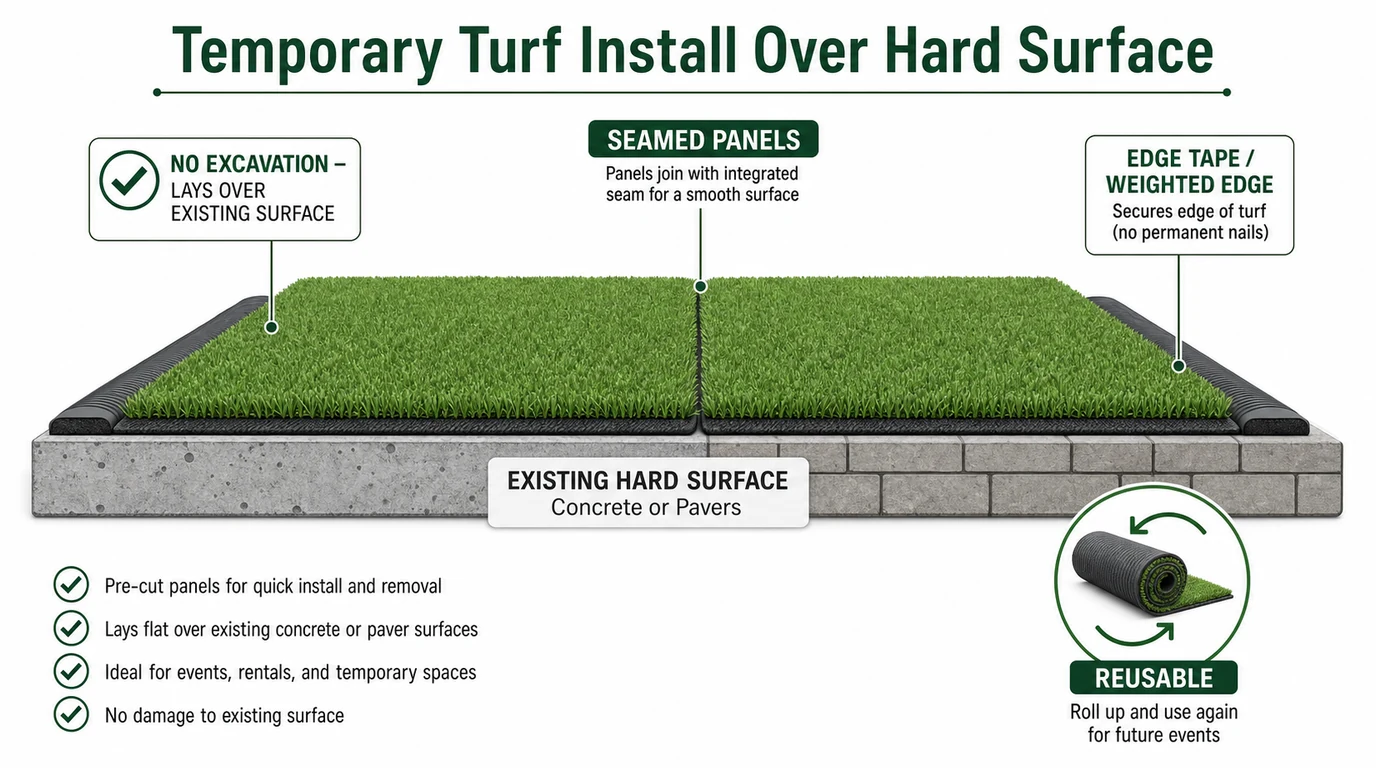
The method is simpler than most people expect, and critically — it requires no excavation, no compacted base, and no permanent anchoring.
Over Concrete, Pavers, or Asphalt
- Clean the surface. Sweep or blow off debris. Any standing dirt or grit will create lumps under the turf.
- Roll out and cut. Lay your turf rolls with the grain running the same direction. Use a utility knife and straight edge for clean cuts at edges and perimeters.
- Seam the panels. Where rolls meet, butt the edges together (no overlap), and use seaming tape with outdoor carpet adhesive underneath. For a temporary install where you’re pulling everything up afterward, a strong double-sided tape is often sufficient for same-day or overnight events.
- Secure the perimeter. For indoor events on smooth concrete, double-sided carpet tape at all perimeter edges holds well and releases cleanly. For outdoor hard surfaces, weight the perimeter with edge trim, sandbags, or furniture placed on the border. Avoid mechanical fasteners (screws, staples) if you need the surface undamaged on removal.
For a deeper look at install methodology, our how to install artificial turf guide walks through base prep and seaming in detail — most of the seaming principles transfer directly to temporary installs.
Managing Foot Traffic and Load
For heavy trade show foot traffic or high-heel-heavy event environments, a denser, heavier-face-weight turf holds up better. Spiked heels on light-pile turf can pull fibers. A face weight of 60+ oz tends to be more durable for this. Likewise, any rolling equipment (AV carts, dollies) should use a solid-rubber wheel rather than a narrow metal caster, which can dig into the backing.
Seaming Invisible Enough for Photography
For photo-heavy events, take care at the seams. Brush the pile toward the camera side, and make sure the blade direction is consistent across panels. From a normal viewing angle or camera focal length, a well-done seam disappears.
Rental vs. Purchase: Which Makes More Sense?
If this is a one-time event with no future use in mind, renting from an event rental company may be the right call — you skip the storage challenge and don’t tie up capital in turf inventory.
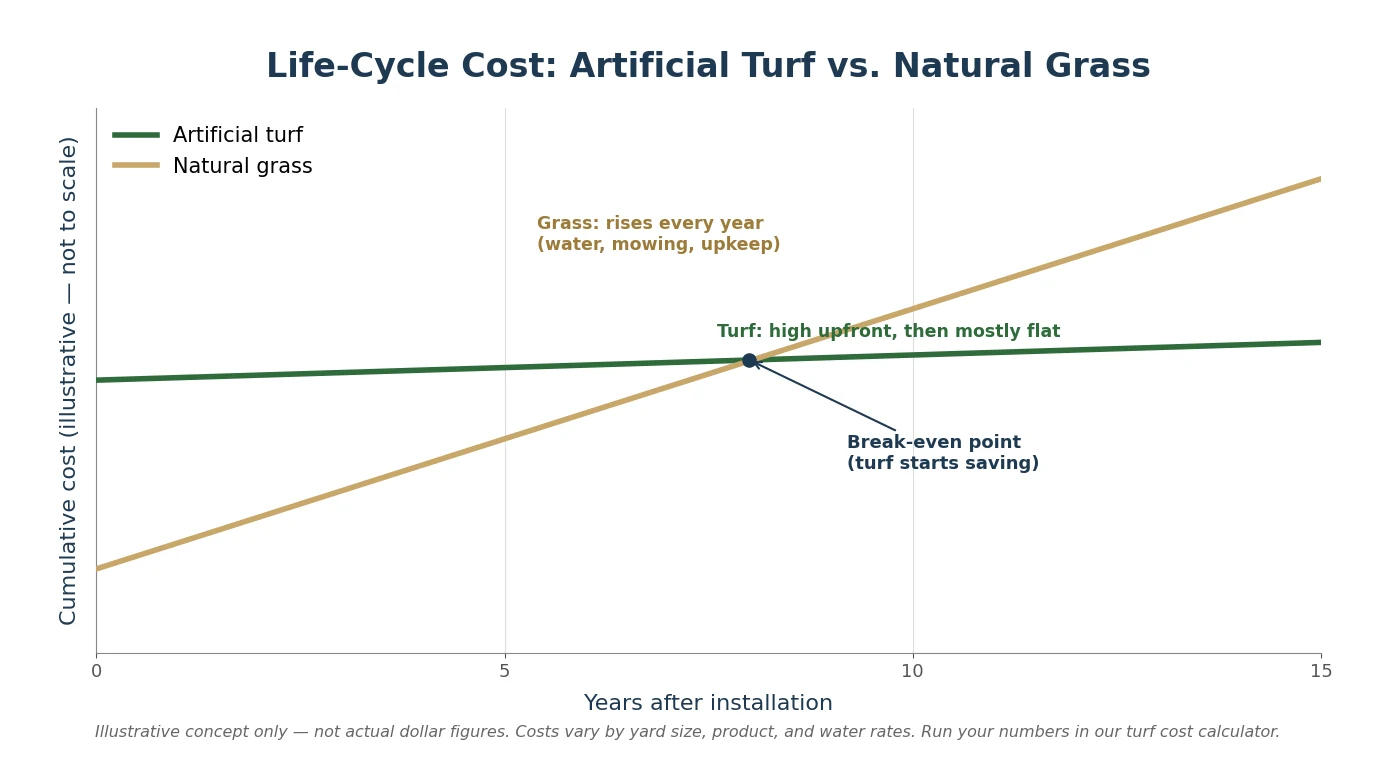
If you run events regularly — a venue that hosts dozens of events per year, a corporate team that does seasonal activations, an event production company with multiple clients — buying rolls is almost always more economical by the second or third use. Turf purchased for temporary installs can last for dozens of events if it’s rolled and stored correctly. Roll it onto a tube or core (never fold it, which creases the backing), store it flat or on end in a dry space, and it’ll be ready for the next call.
The math works quickly. Our artificial turf calculator can help you estimate material cost for your square footage. Compare that to what you’d pay to rent the same coverage area three or four times, and purchase usually wins.
How The Turf Yard Supplies Event Projects
We work with event coordinators, trade show exhibitors, venue operators, and corporate marketing teams across Arizona and Utah. We cut turf to your specified dimensions from our Mesa yard, which means you’re not paying for rolls twice the size you need or trying to work around standard retail lengths.
Our commercial turf page covers the full scope of what we supply for commercial and event applications. If you’re unsure which product makes sense — pile height, face weight, blade color — reach out to our team with your square footage and event type, and we’ll recommend the right fit and cut your order to spec.
Supply Your Next Event with Turf
We cut event and commercial turf to size from our Mesa yard and ship across Arizona and Utah. Tell us your square footage and we'll get you a quote.
A Note on Arizona and Utah Conditions
For outdoor events in Arizona — especially summer months in Phoenix, Scottsdale, Mesa, or anywhere in the Valley — plan around heat. Turf over concrete in full August sun will get hot, as will any outdoor surface. A quick rinse from a hose brings surface temps down fast, and shaded venues or evening events sidestep the issue entirely. See our full breakdown in does artificial turf get hot if you’re planning an outdoor summer install.
For Utah events — particularly spring events in Salt Lake City or Provo where morning temperatures can still dip — turf laid over cold pavement holds up fine. No freeze-thaw concern for a temporary surface install the way you’d have with a permanent base.
When you’re ready for materials, our team supplies commercial and event turf from our Mesa yard with cut-to-spec orders across the Arizona service area and Utah. We also carry wholesale quantities for event production companies and repeat commercial buyers through our artificial turf wholesaler program. Talk to a turf expert and we’ll help you plan the right product and quantity for your next install.